SPECIAL TOPICS / MISE AU POINT
AWARENESS, KNOWLEDGE AND ATTITUDES TOWARDS EPILEPSY: A REVIEW OF A DECADE’S RESEARCH BETWEEN 2000 AND 2010
PRISE DE CONSCIENCE, CONNAISSANCE ET ATTITUDES ENVERS L'ÉPILEPSIE: REVUE D'UNE DÉCENNIE, 2000 - 2010
- Centre for Clinical and Quality of Life Studies, Faculty of Medicine and Health Sciences, Universiti Sultan Zainal Abidin, Terengganu, Malaysia
ABSTRACT
The medical literature related to awareness, knowledge and attitudes (AKA) towards epilepsy was reviewed from the perspective of research trend since 2000 until 2010. Several databases i.e. PubMed, Science Direct, MedLine, Genamics, EBSCO Host and Springer Link were assessed to search for the relevant literatures using the keywords; epilepsy, awareness, knowledge, attitudes, 2000-2010. Three main parameters were measured i.e. awareness, knowledge and attitudes. Our review showed that despite a general high level of awareness, there was a serious lack of accurate knowledge regarding epilepsy which has probably led to the widespread of negative attitudes towards people with epilepsy (PWE) as well as the disease itself. Attitudes were the most commonly-measured parameter for the past ten years. It is also apparent that AKA level was better in developed countries compared to developing and poorer countries. Apart from that, methodological issues, challenges for future research, suggestions and future research directions were also discussed. Further worldwide research on AKA towards epilepsy should be targeted with a view to develop more innovative and effective epilepsy-educational programme to ensure that treatment is consistently accompanied by sound AKA in attempts to improve patients’ health-related quality of life (HRQoL).
Keywords: Epilepsy, awareness, knowledge, and attitudes.
INTRODUCTION
Epilepsy, a universal disorder that affects nearly 50 million people in the world has always been poorly understood by society and has frequently been associated with numerous myths and beliefs. Cultural beliefs and misconceptions about epilepsy coupled with its occasional dramatic clinical manifestations influence the care-seeking behaviour of people with epilepsy (PWE), with a large proportion of epileptic population in certain countries resorting to complementary and alternative medicine for treatment despite the advancement in conventional treatment. This phenomenon thus highlights the importance of improvement in awareness, knowledge, practices and attitudes towards epilepsy among patients, their families or caregivers as well as the public in attempt to ensure health-related quality of life (HRQoL) is not compromised. Although the HRQoL of PWE is primarily determined by the duration of the disease and the extent of seizure control, other non-epileptic parameters such as social and psychological factors have also been shown to be critically important. These closely interrelated social factors include social anxiety, parental anxiety, employment and social stigma [1,2].
Measuring awareness is important in order to obtain a general perception and picture among the surrounding people towards epilepsy. Hence, there is a clear indication to objectively assess the community’s level of awareness about this ailment and subsequently work towards improving this condition [3]. Shafiq et al. [3] further identified a dearth of public awareness as an important factor in the high prevalence of negative attitudes towards epilepsy and epileptic people.
Knowledge with regard to epilepsy is another important factor in reducing the impact of seizures, potentially harmful self-management practices, and the emotional impact of both seizures and treatment because increased knowledge may lead to an improvement in HRQoL not only for patients but also their families [4,5,6]. Therefore, knowledge is a vital factor in improving the ability to cope successfully with epilepsy by minimizing its impact on social and psychological functioning [7]. Furthermore, knowledge about epilepsy would be helpful in diminishing the perceived stigmatization or feelings of social isolation among PWE [4]. Researchers and clinicians who wish to develop and implement such strategies should be encouraged to first familiarize themselves with the stigmatization which accompanies epilepsy, both actual and perceived [6].
It is well known that PWE are socially discriminated against on the ground of widespread negative public attitudes, misconceptions and defensive behaviours. The most frequent false beliefs imposed upon PWE are related to mental illness, retardation and emotional disturbances in the patients [8]. It is conceivable that negative attitudes displayed by the public towards epilepsy may have stemmed from deficient or incorrect information about epilepsy [3].
Stigma is defined as any social attribute that is deeply discrediting for an individual and, in the case of epilepsy, it can significantly affect the HRQoL of the patients in many everyday activities such as going to school, working, driving, creating a family and obtaining insurance. The stigma associated with any disorder is determined not only by the actual characteristics of the disorder but also by the social stereotypes concerning it, created by the lack of information, misconceptions and unfounded fears. In the case of epilepsy, stigma seems to be largely based on the public perception of epilepsy as a disease that can unpredictably cause a violent and frightening attack on the patient’s mental faculties, that is incurable, that affects the patient’s personality, and that may be transmitted to his/her offspring. Such perceptions, although not entirely or necessarily misconceptions, when become social stereotypes obviously cause prejudices and rejections towards anyone with epilepsy. Hence, if these problems are to be dealt with effectively, a systematic study concerning awareness, knowledge, and attitudes towards epilepsy is a necessary first step. Moreover, a review covering these significant investigations could be very beneficial in defining common areas of both deficiency and strength to improve what is lacking. Other than help to raise the understanding level of the progress that has been made in AKA towards epilepsy research, hopefully it can also provide direction as to where future efforts need to be focused and emphasized.
METHODS
Search strategy and selection criteria
The PubMed, Science Direct, MedLine, Genamics, EBSCO Host and Springer Link databases were searched using the keyword « epilepsy », combined with each of the following: « awareness », « knowledge » and « attitudes ». When the first keyword, epilepsy was searched, 20,000,000 hits were obtained. When the word awareness was added, the results were decreased to 670,000 and later down to 114,000 when the third keyword, knowledge was included. With the final addition of the keyword, attitudes and the time frame (2000-2010), only 80 results surfaced. Sixty-six articles met the inclusion criteria which were: 1) research-based, 2) English language and 3) full-length articles. All related issues mainly from Seizure (European Journal of Epilepsy), Epilepsy and Behaviour, Epilepsia (The Journal of International League against Epilepsy), Arquivos de Neuro-Psiquiatria, Neurosciences, Social Science and Medicine, Annals of African Medicine, Epileptic Disorders, Acta Neurologica Scandinavica, Journal of Indian Medical Association and Neurology Asia (formerly known as Neurological Journal of South East Asia) and the International Journal of Collaborative Research on Internal Medicine and Public Health were included.
Data collection and analysis
A total of 66 research articles from 36 countries were found via PubMed, Science Direct, MedLine, Genamics, EBSCO Host and Springer Link databases. Basically, three parameters i.e. awareness, knowledge and attitudes were the main focus. The specific parameters and the main findings of each article were closely-examined for details such as authors, title of research, country, year and socio-demographic background to provide comprehensive information. Besides the demographic distribution of respondents, the investigations’ design, study setting, year of publication, sample and number of sample were also dissected and categorized accordingly. Almost every country in Asia had conducted their own studies on awareness, knowledge and attitudes towards. Most articles had originated from Cameroon (n=6), Malaysia (n=5) and the United States of America (n=4). Three studies were conducted in each of these countries; South Korea, Brazil, Oman, Turkey, Zambia, Hong Kong and India. Greece, Vietnam, Jordan and Kuwait were represented by two studies respectively. On the other hand, only one study had been conducted in Iran, Sweden, Kenya, Hungary, Bengal, Pakistan, Laos, Bosnia and Herzegovina, Croatia, France, Trinidad and Tobago, Nigeria, Burkina Faso, Tanzania, New Zealand, United Arab Emirates, Senegal, Thailand, United Kingdom, Myanmar, Italy and Indonesia. This review has an international focus on patients’, parents’, families’, caregivers’, healthcare providers’ awareness, knowledge and attitudes towards epilepsy and provides a discussion of research trends for the past decade and recommendations for future directions.
RESULTS
Demographic indicators
From 2000 until 2010, the number of total population of respondents was approximately 98, 381. However, the number of total population was smaller than expected because this information was not available in some literature – Table 1.
Age
The publications included in this review showed several age ranges. They covered children from as young as 10 to 16 years (n=22,069), young adults from 18 to 25 years (n=35,224), general adults from 29 to 49 years (n=18,432) and the elderly from 50 to 65 years (n=1,152). Hence, the group most-researched involved young adults, in whom epilepsy is not uncommon and the prevalence is high -Table 1.
Gender
The percentage of female respondents was generally higher ( 50.7% to 87.3%) than males (12.7% to 49.3%) in 43 research studies in almost all countries except for Italy, Thailand, Pakistan, Bengal, Oman, Jordan, UAE, Nigeria and Zambia in which the opposite was noted – Table 1.
Ethnicity, Religion and Locality
The respondents were largely represented by the main ethnic group within each country for several countries namely Malaysia, Hong Kong, South Korea, Pakistan, Oman, Kuwait, Jordan, Iran, Nigeria, Trinidad and Tobago, New Zealand, Greece and United State of America. While for other countries the highest number of respondents was represented by the major religion of the population, states or district with the largest population, mother tongue language of the population or location of the study – Table 1.
Location
Most of the AKA research were carried out in developing countries in which 22 articles had originated from Asia countries, 15 articles from the African continent and 13 articles from Middle East countries. Nonetheless, developed countries like the United States of America, United Kingdom, Canada, France, New Zealand, Greece, Italy and Sweden were covered by the rest of the articles (n=17) – Table 1.
Majority of the studies was based on cross-sectional design and they have been conducted throughout 35 different countries all over the world. The sample recruited (n = 98,381) included PWE, non-PWE, parents, healthcare providers, teachers, students, children and public whereby non-PWE was the majority. The most frequently assessed parameter for the past decade was attitudes, followed by knowledge, awareness, perception, familiarity, understanding, practice, belief and behaviour. The main findings for each study are summarized in Table 2.
Parameters
For the past decade, psychological and behavioural studies of epilepsy and seizure have been focused on measuring different parameters: awareness, knowledge, attitudes, perception, familiarity, understanding, practices, belief, and behaviour. Our review discovered that attitudes had been the most frequently-measured in almost every published research followed by knowledge, and awareness. The least common parameters measured were belief and behaviour. Beginning from the year 2004 onwards, there was an overall increase in the number of research on these parameters among PWE and other members of the community carried out globally – Figure 1.
DISCUSSION
This paper intends to provide a review of published research of AKA towards epilepsy. Data from previous studies over the past decade have provided a clearer picture of the overall overview on this matter. Moreover, methodological issues, challenges for future research, suggestions for future research directions and limitations were also discussed.
Overall findings
According to this review, the awareness level in almost every country was mostly high, between 80% and 100%. High prevalence of this disease i.e. 50 million PWE worldwide could be one of the reasons that people are rather aware of the disease. The familiarity towards this disease was also considerably high since a huge proportion of the public mingled with PWE in their daily life within their surrounding society. However, as compared to studies conducted in other countries, the awareness level of epilepsy in poor communities is still limited and this gives rise to negative attitudes and poor practices [28].
Despite high awareness level, knowledge level however was still very limited. Obviously, the main problem was lack of accurate knowledge regarding this illness. Moreover, the existence of incorrect knowledge plus false beliefs surrounding this disease has commonly been spread from person to person among the community, worsening the matter. This indicated that epilepsy education has been largely inadequate and ineffective especially in developing countries. Educational programmes should be implemented continuously among children, youth, adults and the elderly. They need to be constantly-equipped with up-to-date knowledge via the most effective ways. Thus, development of epilepsy education programme utilizing all sorts of resources such as the internet, mass-media and telecommunication systems could play a crucial role in improving the knowledge in this ICT-driven era.
Overall, negative attitudes were still prominent. The attitudes toward epilepsy could be considered as negative among public all over the world except for in the United States of America [22]. The public possessed a positive attitude about their association with PWE, their employment, having children or even their ordinary life in the community [47] but they imposed a negative attitude with regard to their children associating with PWE and marrying epileptic person like those in Hong Kong [70] and Malaysia [46]. Although epilepsy is a well-known disease, negative attitudes unfortunately still prevail [16]. People in rural communities especially perceive epilepsy as a feared and dreaded disease because of its alleged association with evil spirits and witchcraft [26]. Consequently, PWE faces serious social stigmatisation and may even be ostracized by the society [38]. The majority of negative attitudes were significantly associated with the misunderstanding of epilepsy in the first place [16], emphasizing the importance of health education for the people.
Expectedly, respondents in developed countries demonstrated an overall better AKA level compared to people in developing countries. Specifically, population in developed countries like the United States of America [22], United Kingdom [42], New Zealand [40], Greece [44] and France [61] demonstrated better AKA compared to developing countries like Asian countries, Middle East countries as well as African countries. This could be due to better education, higher socioeconomic status and significantly enhanced level of thinking possessed by respondents in developed countries such as the United States of America, German, and Japan. However, in countries with low resources, poor awareness about epilepsy, stigma associated with the disorder, ignorance about its treatment and restricted access to healthcare have imposed a negative influence on AKA as well as on their HRQoL. Differences in public AKA between eastern and western countries might also reflect the underlying sociodemographic and cultural differences in the perception of this condition. These sociodemographic and cultural differences could probably be influenced by political situation, economic growth, education system, health policy and sociocultural diversity in the respective countries.
Overall, attitudes have been identified as the most commonly-measured parameter in AKA followed by knowledge and awareness. This is rather expected since this illness is frequently associated with stigmatisation, prejudice and discrimination. Therefore, assessing attitudes is certainly crucial in order to determine the level of stigma towards this brain disorder.
Methodological issues and challenges for future research
The largest problem in most research is the lack of outcome studies to test for the effectiveness of interventions. Out of the 66 studies conducted, only one was an intervention study, while the rest were all non-interventional. There should be more intervention studies as a continuity of the usually-conducted cross-sectional studies since most have suggested that almost similar educational programmes should be embarked as the best solutions for the problem. Interventional studies could be in the form of developing and testing educational programme, launching awareness campaign, introducing medical education or even developing new system or device with the primary objective of improving knowledge.
Another pertinent issue with the assessment measures employed was that some terms were not standardized across studies. For example « awareness », « familiarity », « knowledge », « understanding », « perception », « belief », « behaviour », « practices » and « attitudes » towards epilepsy were measured by different scales in different studies. This makes comparisons of the effectiveness of different approaches rather tedious and could not be standardized. Another reasonable concern is whether these scales measure the parameters in a meaningful way. For example, exactly how does one measure « awareness », « knowledge » or « attitudes » in a series of yes-no-not sure questions or Likert rating scales? When a significant change is statistically shown on such measurements, does it actually reflect a clinically significant change [73] in respondents’ level of AKA? These concerns could probably be addressed in future instrument development with more meaningful interpretation between scale scores and real-life adaptation and practice.
Furthermore, there was no established and standardized instrument for measuring AKA. Most questionnaires have been developed by researchers specifically for the purposes of their studies alone, assessing their desired parameters. Because of this, these instruments vary in their scope/objectives and some cover a wide range of topics, which makes it rather difficult to compare and draw general conclusions on the overall attitude and degree of knowledge of PWE. Some researchers did not give identification name for their developed questionnaires. Hence, it is inconvenient to gather and clearly identify the instruments which have been utilized for this type of study for many years before.
Amongst others too, researchers or instrument developers did not seem keen to address the impact of different types of epilepsy namely primary generalized seizure and partial seizure with a variety of accompanying subtypes i.e. absence seizure, atypical absence seizure, myoclonic seizure, atonic seizure, tonic seizure, clonic seizure, tonic clonic seizure, simple partial seizure, complex partial seizure and secondary generalized seizure. Each subtype requires specific needs whether in terms of treatment or regular daily basis and faces slightly different psychosocial issues. Therefore, it is neither appropriate nor accurate to utilise similar instrument for PWE who are diagnosed with different subtypes of epilepsy. The domains and items could probably be modified to suit the major issues affecting them. Hence, developing specific instrument according to subtypes of epilepsy could be another step forward in research of this nature.
Suggestions and future research directions
Epilepsy education campaign and health promotion have been shown to be effective in improving health outcomes of PWE. Educational programmes to enhance epilepsy self-management have often shown improvements in knowledge. A study carried out in Hungary [8] demonstrated that educational campaigns are effective in changing as well as improving knowledge about epilepsy among the population and diminish the negative attitudes against PWE [33]. Larger and comprehensive community-based educational programme is very much essential to bring about a change in negative attitude towards epilepsy [21]. Therefore, more interventional focus on epilepsy education including PWE, their families, caregivers and public should be devised, tested and implemented over-time in efforts to gradually alter knowledge and attitude components of PWE as well as their surrounding community.
Rather than dealing with the clinical manifestations of epilepsy alone, PWE are equally (if not more) affected by the psychosocial issues surrounding it. Because of that, besides being treated medically, PWE should also opt for psychosocial treatment or alternative therapies. However, according to Mittan [73], the development of psychosocial treatment programs in epilepsy such as educational interventions, computer-based patient education, medical education and counseling therapies has not kept pace with the development of medical treatments nowadays. This is a very troubling state of affair given that the provision of pharmacological therapies should ideally be balanced with psychosocial intervention services. Formal psychosocial treatment interventions definitely require a structured programme and sustainable funding incentives by authorities in their respected fields. These interventions, for example, including books, pamphlets and a host of epilepsy association programs should utilise the increasingly popular internet resources and devices for maximum impact and effectiveness on health outcomes.
Apart from quantitative measures, qualitative approaches were also necessary to uncover the ongoing psychosocial problems surrounding epilepsy in more depth. According to Cresswell [74] and Green and Thorogood [75], a qualitative approach is required to examine what underlines social processes and to establish what they mean and how people make sense of this meaning in their lives. This approach will further allow researchers to achieve explanatory depth, relate particular aspects of behavior to a wider context, and allow for the discovery of any unexpected issues. Therefore, it is only reasonable for more qualitative measures to be included in future research.
Limitations
There are several limitations in this review. First, it was limited to only English-language literature, whilst it should be noted that there may be non-English journal articles available which were not identified and analysed. Besides that, this review did not include manual search of articles which are very limited in our resource centre. Our electronic searches also only covered research articles from two electronic databases namely Medline and Science Direct. In addition, articles were reviewed mainly by their title and abstract, those containing relevant AKA-related information as a minor portion of the results could have been overlooked. Hence, it should be noted that there may be published research articles which could have been overlooked, in which a more comprehensive coverage and analysis could have been carried out if they were accessible.
CONCLUSION
This review highlights the ever-growing need for further research on AKA towards epilepsy. Limited knowledge and the widespread negative attitudes towards this brain disorder despite its prevalence and high awareness in the society indicated that serious attention plus various measures have to be taken to overcome this hurdle. The obvious gap between the AKA level of respondents in developed countries in comparison to those in developing and poor countries emphasizes the critical importance of epilepsy education in addition to effective delivery methods to the targeted population. In the developed nations, high level of literacy, wider scope of media coverage and accessibility of healthcare services to the community have resulted in better understanding and a remarkable decline in misperceptions and myths of the nature of epilepsy. Expectedly, attitude was the most commonly-measured parameter followed by knowledge and awareness since this illness is frequently associated with stigmatisation, prejudice and discrimination. Methodological short-comings and future challenges should also be tackled in order to attain the ultimate goal of patient-centered management – improvement of the quality of life. Future research directions could be introduced for more improvised and impactful outcomes besides the limitations and suggestions that need to be taken into consideration.
CONFLICT OF INTEREST STATEMENT
The author of this review article is also the author of Awareness, Knowledge and Attitudes Towards Epilepsy Among Rural Populations In East Coast Peninsular Malaysia: A preliminary exploration which has been published in Seizure 2010; 19:280-90.
| ACKNOWLEDGEMENT |
| We would like to thank Ms Wan Putri Elena Wan Dali and Ms Tuan Sharifah Diana Syed Ahmad for their assisstance in compiling the journal articles. |
Table 1. An overview of demographic indicators of the research articles according to country and year.
| No |
Country |
Year |
Title |
Age (year) Mean/MeanSD/Range |
Gender (%)/ratio |
Ethnicity/Religion/Locality (%) |
| 1 |
Bengal |
2007 |
Epilepsy awareness among parents of school children: a municipal survey |
NA |
Male = 76.9 Female = 23.1 |
NA |
| 2 |
Bosnia and Herzegovina |
2009 |
First population study of the general public awareness and perception of epilepsy in Bosnia and Herzegovina |
15.0 to 66.0 |
Male = 48.0 Female =52.0 |
Urban = 48.3
Rural = 51.7 |
| 3 |
Brazil |
2007 |
Awareness, attitudes and perceptions on epilepsy in Southern Brazil |
32.2 14.8 |
Male = 26.4
Female = 73.6 |
NA |
|
|
2007 |
Knowledge and attitudes toward epilepsy amongst students in the health area: intervention aimed at enlightenment |
NA |
NA |
NA |
|
|
2001 |
Knowledge and attitudes toward epilepsy among primary, secondary and tertiary level teachers |
29.0 to 49.0 |
Male = 33.3
Female = 66.7 |
NA |
| 4 |
Burkina Faso |
2004 |
Knowledge of epilepsy and attitudes towards the condition among schoolteachers in Bobo-Dioulasso (Burkina Faso) |
30.0 to 50.0 |
Male = 46.5
Female = 53.5 |
Christian = 68.4
Muslim = 30.3
Others = 1.3 |
| 5 |
Cameroon |
2010 |
Knowledge, attitudes and practices with respect to epilepsy among student nurses and laboratory assistants in the South west Region of Cameroon |
26.0 4.0 |
Male = 19.0
Female = 81.0 |
Catholic = 49.0
Protestant = 47.0
Others = 4.0 |
|
|
2010 |
A community survey of knowledge, perceptions, and practice with respect to epilepsy among traditional healers in the Batibo Health District, Cameroon |
52.1 15.9 |
Male = 90.0
Female = 10.0 |
Catholic = 35.3
Protestant = 53.9
Others = 10.8 |
|
|
2009 |
A survey of public knowledge, attitudes, and practices with respect to epilepsy in Badissa village, Centre Region of Cameroon |
48.1 15.0 |
Male = 57.3
Female = 42.7 |
Sanaga = 95.7
Others = 4.3 |
|
|
2009 |
General public knowledge, attitudes, and practices with respect to epilepsy in the Batibo Health District, Cameroon |
35.2 14.7 |
Male = 47.0
Female = 53.0 |
NA |
|
|
2009 |
General public awareness, perceptions, and attitudes with respect to epilepsy in the Akwaya Health District, South-West Region, Cameroon |
34.6 1.9 |
Male = 54.0
Female = 46.0 |
Animist = 5.4
Catholic = 50.2
Muslim = 2.8
Protestant = 41.6 |
|
|
2009 |
Public awareness, perceptions, and attitudes with respect to epilepsy in Ebolowa and Sangmelima – Urban Cameroon |
27.4 10.4 |
Male = 56.1
Female = 43.9 |
NA |
| 6 |
Croatia |
2009 |
First population study of the general public awareness and perception of epilepsy in Croatia |
15.0 to >66.0 |
Male = 47.5
Female = 52.5 |
Urban = 58.2
Rural = 41.8 |
| 7 |
France |
2010 |
Knowledge of epilepsy in the general population based on two French cities: implications for stigma |
48.7 18.4 |
Male = 47.4
Female = 52.6 |
Haute-Vienne = 49.7
Creuse = 50.3 |
| 8 |
Greece |
2006 |
A survey of public awareness, understanding, and attitudes toward epilepsy in Greece |
20.0 to 60.0 |
Male = 49.3
Female = 50.7 |
Greeks = 94.5
Immigrants = 5.5 |
|
|
2005 |
Knowledge and attitude of the Greek educational community toward epilepsy and the epileptic student |
35.0 to 50.0 |
Male = 49.3
Female = 50.7 |
NA |
| 9 |
Hong Kong |
2004 |
Pilot survey of public awareness, attitudes and understanding towards epilepsy in Hong Kong |
28.0 15.0 |
Male = 52.0
Female = 48.0 |
Cantonese = 92.1
Mandarin = 6.9 |
|
|
2002 |
Public awareness, attitude and understanding of epilepsy in Hong Kong Special Administrative Region, China |
NA |
Male = 46.2
Female = 53.8 |
Cantonese = 100.0 |
|
|
2002 |
Public awareness, attitude, and understanding of epilepsy in Hong Kong |
NA |
NA |
NA |
| 10 |
Hungary |
2001 |
Changes in public attitudes toward epilepsy in Hungary: results of surveys conducted in 1994 and 2000 |
1994 = 50.0 |
Male = 47.2
Female = 52.8 |
Urban = 63.3
Rural = 36.7 |
|
|
|
|
2000 = 46.5 |
Male = 47.0
Female = 53.0 |
Urban = 63.6
Rural = 36.4 |
| 11 |
India |
2010 |
Knowledge, attitude and practices among patients of epilepsy attending tertiary hospital in Delhi, India and a review of Indian studies |
18.0 to 60.0 |
Male = 60.0
Female = 40.0 |
Hindus = 74.2
Muslims = 25.8 |
|
|
2008 |
Knowledge, awareness and attitude about epilepsy among schoolteachers in India |
NA |
Male = 61.8
Female = 38.2 |
Urban = 32.9
Rural = 67.1 |
|
|
2006 |
High school students’ knowledge, attitude, and practice with respect to epilepsy in Kerala, Southern India |
14.9 0.8 |
Male = 44.4
Female = 55.6 |
Muslims = 50.9
Hindus = 48.6
Christians = 0.5 |
| 12 |
Indonesia |
2004 |
Public awareness, understanding and attitude towards epilepsy in Bandung, Indonesia |
Male = 39.0
Female = 36.0 |
Male = 46.3
Female = 53.7 |
NA |
| 13 |
Iran |
2009 |
Awareness, understanding and attitudes towards epilepsy among Iranian ethnic groups |
38.9 14.1 |
Male = 47.6
Female = 52.4 |
Persian = 20.0
Azeri = 20.0
Kurd = 20.0
Lur = 20.0
Arab = 20.0 |
| 14 |
Italy |
2007 |
A questionnaire study on knowledge of and attitudes toward epilepsy in school children and university students in Rome, Italy |
Schoolchildren = 16.4 1.5 |
Schoolchildren
Male = 54.7
Female = 45.3 |
School children = 344
University students = 253 |
|
|
|
|
University students = 22.2 2.9 |
University students
Male = 45.1
Female = 54.9 |
|
| 15 |
Jordan |
2007 |
Public knowledge and attitudes towards epilepsy in Jordan |
26.7 10.1 |
Male = 51.0
Females = 49.0 |
NA |
|
|
2006 |
Knowledge of management of epilepsy in young adults in Jordan |
26.7 10.1 |
Male = 50.8
Female = 49.2 |
Jordanian = 69.6
Palestinian = 10.6
Syrian = 11.5
Other = 8.3 |
| 16 |
Kenya |
2006 |
Attitudes and practices of families and health care personnel toward children with epilepsy in Kilifi, Kenya |
NA |
NA |
NA |
| 17 |
Kuwait |
2009 |
Knowledge of, perceptions of, and attitudes toward epilepsy among university students in Kuwait |
21.1 1.8 |
Male = 44.0
Female = 56.0 |
Kuwaitis = 95.0
Others = 5.0 |
|
|
2008 |
Public knowledge and attitudes toward epilepsy in Kuwait |
34.1 10.0 |
Male = 43.1
Female = 56.9 |
Capital = 25.1
Hawalli = 24.8
Al-Farwaniyah = 20.6
Al-Ahmadi = 16.7
Al-Jahra= 12.8 |
| 18 |
Laos |
2007 |
Epilepsy in Laos: knowledge, attitudes, and practices in the community |
PWE = 30.7 |
Male:female 1.1:1.0 |
NA |
|
|
|
Villagers = 31.1 |
Male:female 1.1:1.0 |
|
|
|
|
|
Relatives = 42.8 15.0 |
Male = 34.0
Female = 66.0 |
|
|
| 19 |
Malaysia |
2010 |
Knowledge and Attitudes towards Epilepsy among Malaysian Chinese |
34.7 |
Male = 49.0
Female = 51.0 |
Kuala Lumpur = 20.9
Penang = 18.3
Ipoh = 15.7
Klang = 15.2
Serdang = 10.5
Kajang = 10.2
Shah Alam = 9.2 |
|
|
2010 |
Awareness, knowledge and attitudes towards epilepsy among rural populations in East Coast Peninsular Malaysia: A preliminary exploration |
41.6 18.0 |
Male = 43.4
Female = 56.6 |
Malay = 94.0
Chinese = 5.2
Indian = 0.5
Others = 0.3 |
|
|
2005 |
Awareness and knowledge of epilepsy among students in a Malaysian university |
21.8 2.5 |
Male = 22.6
Female = 77.4 |
Malay = 60.7
Chinese = 26.0
Indian = 6.7
Others = 6.7 |
|
|
2000 |
Public awareness, attitudes and understanding towards epilepsy in Kelantan, Malaysia |
27.0 |
Male = 38.1
Female = 61.9 |
Malay = 81.0
Chinese = 6.0
Indian = 0.6
Others = 12.4 |
|
|
1999 |
Survey of public awareness, understanding, and attitudes toward epilepsy among Chinese in Malaysia |
NA |
Male = 54.1
Female = 45.9 |
Chinese = 100.0 |
| 20 |
Myanmar |
2002 |
Public awareness, attitude and understanding toward epilepsy among Myanmar people |
31.0 |
Male = 42.6
Female = 57.4 |
Urban = 59.1
Rural = 40.9 |
| 21 |
New Zealand |
2002 |
New Zealand community attitudes toward people with epilepsy |
18.0 to >60.0 |
Male = 45.0
Female = 55.0 |
New Zealand European = 77.0
Maori (indigenous persons) = 10.0
Others = 13.0 |
| 22 |
Nigeria |
2005 |
Knowledge, attitude and beliefs about epilepsy among adults in a Northern Nigerian Urban Community |
18.0 to 71.0 |
Male = 56.0
Female = 44.0 |
Hausa-Fulani = 81.5
Yoruba = 9.5
Igbo = 5.0
Others = 4.0 |
| 23 |
Oman |
2003 |
Patient’s perspective on epilepsy: self-knowledge among Omanis |
22.6 4.6 |
Male = 53.0
Female = 47.0 |
NA |
|
|
2001 |
Psychosocial aspects of epilepsy in Oman: attitude of Health Personnel |
37.4 10.0 |
Male = 66.0
Female = 34.0 |
Indian = 41.0
Omani = 29.0
Sri Lankan = 15.0
Egyptian = 6.0
Pakistani = 4.0
Filipino = 3.0
Jordanian = 2.0 |
|
|
2000 |
Attitudes of Omani physicians to people with epilepsy |
35.6 9.6 |
Male = 66.0
Female = 34.0 |
Indian = 40.0
Omanis = 31.0
Sri Lankan = 10.0
Others = 19.0 |
| 24 |
Pakistan |
2007 |
Epilepsy: public knowledge and attitude in a slum area of Karachi, Pakistan |
16.0 to 45.0 |
Male = 63.0
Female = 37.0 |
Hindko = 34.0
Pashto = 32.0
Punjabi = 12.0
Urdu = 10.0
Others = 12.0 |
| 25 |
Senegal |
2005 |
Prevalence of epilepsy its treatment gap and knowledge, attitude and practice of its population in sub-urban Senegal an ILAE/IBE/WHO study |
0.0 to 40.0 |
Male = 46.9
Female = 53.1 |
NA |
| 26 |
South Korea |
2010 |
Familiarity with, knowledge of, and attitudes toward epilepsy among teachers in Korean elementary schools |
38.4 10.2 |
Male = 12.7
Female = 87.3 |
NA |
|
|
2009 |
Familiarity with, understanding of, and attitudes toward epilepsy among people with epilepsy and healthy controls in South Korea |
18.0 to 65.0 |
Male = 48.5
Female = 51.5 |
Kyungi-Do, Inchon = 52.5
Gyeongsang-do, Daegu, Busan, Ulsan = 36.4
Jeolla-do,Gwangju = 8.9
Others = 2.2 |
|
|
2004 |
Familiarity with, knowledge of, and attitudes toward epilepsy in residents of Seoul, South Korea |
44.6 14.9 |
Male = 32.6
Female = 67.4 |
NA |
| 27 |
Sweden |
1991 |
Attitudes of rural people in central Ethiopia toward epilepsy |
18.0 to 45.0 |
Male = 41.6
Female = 58.4 |
Muslim = 53.7
Christian = 46.3 |
| 28 |
Tanzania |
1993 |
Knowledge, attitude, and practice toward epilepsy among rural Tanzanian residents |
40.2 |
Male = 50.0
Female = 50.0 |
NA |
| 29 |
Thailand |
2010 |
Public familiarity with, knowledge of, and predictors of negative attitudes toward epilepsy in Thailand |
37.6 |
Male = 52.9
Female = 47.1 |
Capital = 16.3
Central = 22.6
North = 19.0
Northeast = 19.6
South = 22.5 |
| 30 |
Trinidad and Tobago |
2009 |
Knowledge of, attitudes toward, and perceptions of epilepsy among college students in Trinidad and Tobago |
21.6 3.6 |
Male = 43.0
Female = 57.0 |
Indian = 49.0
African = 29.0
Mixed = 21.0
Chinese = <1.0
Other = <1.0 |
| 31 |
Turkey |
2010 |
Knowledge of, perception of, and attitudes toward epilepsy of schoolchildren in Ankara and the effect of an educational program |
13.1 1.2 |
Male = 47.6
Female = 52.2 |
Ulubatli Hasan PS = 38.7
Nazim Akcan PS = 26.9
ATO 65th year PS = 34.4 |
|
|
2009 |
Do knowledge of, perception of, and attitudes toward epilepsy affect the quality of life of Turkish children with epilepsy and their parents? |
Children = 13.5 3.2 |
Children:
Male = 56.8
Female = 43.2 |
NA |
|
|
|
|
Parents = 38.5 6.8 |
Parents:
Male = 36.2
Female = 63.8 |
|
|
|
2007 |
Teachers’ perceptions in central Turkey concerning epilepsy and asthma and the sort-term effect of a brief education on the perception of epilepsy |
NA |
Male = 54.5
Female = 45.5 |
NA |
| 32 |
United Arabic Emirates |
1998 |
Public awareness and attitudes towards epilepsy in the United Arab Emirates |
28.9 10.1 |
Male = 52.0
Female = 48.0 |
NA |
| 33 |
United Kingdom |
2004 |
Public knowledge, private grief: a study of public attitudes to epilepsy in the United Kingdom and implications for stigma |
16.0 to 75.0 |
Male = 44.6
Female = 55.4 |
White British = 87.4
Other White = 4.6
Mixed = 1.0
Asian subcontinent = 3.6
Black British = 1.8
Chinese = 0.6 Any other = 1.0 |
| 34 |
United States of America |
2010 |
Knowledge, attitudes, and practice toward epilepsy (KAPE): A survey of Chinese and Vietnamese adults in the United States |
18.0 to >65.0 |
Male = 46.6
Female = 53.4 |
Chinese = 57.6
Vietnamese = 40.2 |
|
|
2006 |
Teachers’ knowledge about epilepsy and attitudes toward students with epilepsy: results of a national survey |
42.8 10.8 |
Male = 14.5
Female = 85.5 |
White = 96.7
African-American = 2.1
Hispanic = 0.4
Native American = 0.4
Asian = 0.4 |
|
|
2004 |
Teacher’s attitudes toward students with epilepsy: results of a survey of elementary and middle school teachers |
40.4 10.7 |
Male = 13.0
Female = 87.0 |
Central Kentucky = 48.5
Western Kentucky = 24.2
Eastern Kentucky = 27.3 |
|
|
2002 |
Epilepsy familiarity, knowledge, and perceptions of stigma: report from a survey of adolescents in the general population |
13.0 to 18.0 |
Male = 47.0
Female = 53.0 |
White/Caucasian = 63.0
Black/African-American=14.0
Asian = 5.0
Latino = 12.0
Native American = 1.0
Others = 5.0 |
| 35 |
Vietnam |
2007 |
Knowledge, attitudes and practice toward epilepsy among adults in Ba Vi, Vietnam: first report from the population-based EPIBAVI study |
19.0 to 71.0 |
Male = 46.5
Female = 53.5 |
NA |
|
|
2003 |
Survey of public awareness, attitudes, and understanding toward epilepsy in Nhan Chinh, Hanoi, Vietnam, in 2003 |
15.0 to 80.0 |
Male = 38.0
Female = 62.0 |
NA |
| 36 |
Zambia |
2007 |
Epilepsy-related knowledge, attitudes, and practices among Zambian police officers |
31.8 7.0 |
Male = 71.3
Female = 28.7 |
NA |
|
|
2007 |
Zambian health care workers’ knowledge, attitudes, beliefs, and practices regarding epilepsy |
34.3 |
Male = 23.0
Female = 77.0 |
Urban = 58.5
Rural = 41.5 |
|
|
2006 |
Knowledge, attitudes, behaviours and practices regarding epilepsy among Zambian clerics |
40.7 |
Male = 77.9
Female =22.1 |
Catholic = 4.5
Liberal Protestant = 63.8
Strict Protestant = 28.6
Jehovah’s witness = 3.1 |
Table 2. An overview of study design, study setting, year, and sample that have assessed awareness, knowledge, and attitudes towards epilepsy from year 2000 to 2010.
| No |
Authors |
- Study design
- Study setting
- Year
|
Respondents |
Sample (n) |
Parameters |
Main findings
|
| 1 |
Ab Fatah Ab Rahman [9] |
- Cross-sectional
- Penang, Malaysia
- 2005
|
University students |
289 |
Awareness & Knowledge (AK) |
Awareness = high
Familiarity = moderate
Knowledge = poor
Attitudes = indifferent
|
| 2 |
Al-Adawi et al [10] |
- Cross-sectional
- Muscat, Oman
- 2000
|
Doctors |
121 |
Knowledge & Attitudes (KA) |
Knowledge = excellent
Attitudes = negative
|
| 3 |
Al-Adawi et al [11] |
- Cross-sectional
- Oman
- 2003
|
*PWE |
107 |
Perspective & Knowledge (PK) |
Knowledge = moderate/limited
Limited knowledge of PWE condition
Inaccurate indications of epilepsy and incorrect responses to safety and compliance
A need for improving PWE knowledge
|
| 4 |
Al-Adawi et al [12] |
- Cross-sectional
- Oman
- 2001
|
Health personnel |
121 |
Attitudes (A) |
Knowledge = excellent
Attitudes = negative (cognitive & behaviour)
Realities regarding PWE should be publicized – PWE are capable of having a normal life and being an integral part of society
|
| 5 |
Al-Rashed et al [13] |
- Cross-sectional
- Kuwait
- 2009
|
University students |
753 |
Knowledge, Perceptions & Attitudes (KPA) |
Knowledge = moderate
Attitudes = negative
Misconceptions and negative attitudes = high
|
| 6 |
Atadzhanov et al [14] |
- Cross-sectional
- Zambia .2006
|
Clerics |
225 |
Knowledge, Attitudes, Behaviour & Practices (KABP) |
Awareness = high
Familiarity not associated with more knowledge or tolerance
Younger clerics, urban dwellers, those with fewer children and those with more years of formal education – significantly more tolerant
More knowledgeable clerics – recommended PWE to seek care from physician
Formal education – the most important factor in determining tolerance towards epilepsy
|
| 7 |
Austin et al [15] |
- Cross-sectional .United State of America
- 2002
|
High school students |
19,441 |
Familiarity, Knowledge & Perception (FKP) |
Awareness = moderate
Knowledge = poor
Attitudes = negative
|
| 8 |
Awad & Sarkhoo [16] |
- Cross-sectional
- Kuwait
- 2008
|
Healthy public volunteers |
755 |
Knowledge & Attitudes |
Awareness = high
Knowledge = moderate/limited
Attitudes = negative .Negative attitudes – significantly associated with misunderstanding of epilepsy
|
| 9 |
Aydin & Yildiz [17] |
- Cross-sectional
- Konya, Turkey
- 2007
|
Schoolteachers |
275 |
Knowledge, Attitudes Practice (KAP) |
Knowledge = moderate/limited
Attitudes = negative
Practice = poor
Initial rates of acceptance of CWE = significantly low
A significant positive change in the teachers’ perception of epilepsy after education program
|
| 10 |
Bagic et al [18] |
- Cross-sectional
- Bosnia and Herzegovina
- 2009
|
Adults |
1,000 |
Knowledge, Perception & Attitudes (KPA) |
Awareness = high
Familiarity = moderate
Knowledge = moderate
Attitude = positive
Perception = moderate
Practice = moderate
Positive attitudes correlated with knowing PWE and/or witnessing seizure
General awareness and attitudes approached those of developed countries
|
| 11 |
Bagic et al [19] |
- Cross-sectional
- Croatia
- 2009
|
Adults |
1,000 |
Knowledge, Perception & Attitudes (KPA) |
Awareness = high
Familiarity = moderate
Attitude = positive
Perception = positive
Practice = moderate
Positive attitudes correlated with knowing PWE and/or witnessing seizure
|
| 12 |
Bener et al [20] |
- Cross-sectional
- United Arab Emirates (UAE)
- 1998
|
Public residents |
892 |
Awareness, Attitudes & Understanding (AAU) |
Awareness = moderate
Knowledge = moderate/limited
Attitudes = indifferent
Males and females were similarly familiar with the concept of epilepsy
Age group (20-29 years) and education (illiterate) had positive significant effect on awareness of epilepsy
AKA level in UAE < other Western countries
|
| 13 |
Bhattacharya et al [21] |
- Cross-sectional
- Bengal
- 2007
|
Parents of school-going children |
1,068 |
Knowledge, Attitudes & Practices (KAP) |
Knowledge = moderate
Attitudes = indifferent
False belief and negative attitudes lead to barrier in children education
|
| 14 |
Bishop & Boag [22] |
- Cross-sectional
- United States of America
- 2006
|
Elementary and middle school teachers |
512 |
Knowledge & Attitudes (KA) |
Knowledge = moderate/limited
Attitudes = positive
Despite positive attitudes, there were significant deficits in general knowledge, its impact in educational settings and the appropriate management of epilepsy in classroom
|
| 15 |
Bishop & Slevin [23] |
- Cross-sectional
- Kentucky, United States of America
- 2004
|
Elementary and middle school teachers |
135 |
Attitudes (A) |
Attitudes = indifferent
Better scores predicted by more years of experience in teaching students with epilepsy
|
| 16 |
Bozkaya et al [24] |
|
Primary schoolchildren |
851 |
Knowledge, Perceptions & Attitudes (KPA) |
The epilepsy education program was found to be associated with a significant increase in knowledge and positive attitudes towards epilepsy
Students with higher socioeconomic levels performed better on both pre and post tests
|
| 17 |
Choi-Kwon et al [25] |
- Cross-sectional
- Korea
- 2004
|
Public volunteers |
918 |
Awareness, Knowledge & Attitudes (AKA) |
Knowledge = moderate
Attitudes = negative
The significant reasons for negative attitudes – epilepsy was hereditary and untreatable
Word of mouth was most often referenced as a source of knowledge
|
| 18 |
Chomba et al [26] |
- Cross-sectional
- Zambia
- 2007
|
Health care workers |
276 |
Knowledge, Attitudes, Beliefs & Practices (KABP) |
Knowledge = good
Attitudes = positive
Practice = good
Beliefs = moderate
Those who had received both didactic and bedside training and more recent graduates exhibited significantly greater knowledge
Greater knowledge was significantly associated with more social tolerance but having a family member with epilepsy was not
Most PWE are feared and/or rejected by both their families and community
|
| 19 |
Chung et al [27] |
- Cross-sectional
- United States of America
- 2010
|
Chinese-American adults Vietnamese- American adults |
1,615 1,126 |
Knowledge, Attitudes & Practices (KAP) |
Awareness = high
Attitudes = indifferent
Practices = moderate
Younger age, female, Chinese and higher level of education were associated with positive attitude and better knowledge
Noteworthy differences in attitudes and practices in relation to previous studies in Asian countries
|
| 20 |
Cuong et al [28] |
- Cross-sectional
- Nhan Chinh, Hanoi, Vietnam .2003
|
Public volunteers |
1,000 |
Awareness, Attitudes & Understanding |
Awareness = moderate
Knowledge = poor
Understanding = poor
Attitudes = indifferent/slight negative
|
| 21 |
Dantas et al [29] |
- Cross-sectional
- Brazil
- 2001
|
Primary, secondary and tertiary level teachers |
300 |
Knowledge,Practice & Attitudes (KPA) |
Awareness = high
Knowledge = moderate and limited
Attitudes = indifferent
|
| 22 |
Daoud et al [30] |
- Cross-sectional
- Jordan
- 2007
|
Adults |
16,044 |
Knowledge & Attitudes (KA) |
Awareness = high
Knowledge = moderate/limited
Attitudes = indifferent
Younger participants and those with higher education were significantly more positive towards epilepsy
Overall knowledge and attitudes comparable with Asian countries but more negative when compared to Western countries
|
| 23 |
Diamantopoulos et al [31] |
- Cross-sectional
- Greece
- 2006
|
Adults |
750 |
Awareness, Understanding & Attitudes (AUA) |
Awareness = moderate
Understanding = moderate
Attitudes = indifferent
Public’s rejection towards PWE = low
Negative predictive factors – older age, low educational level, unfamiliarity with epilepsy and erroneous beliefs
|
| 24 |
El Sharkawy et al [32] |
- Cross-sectional
- Kilifi, Kenya
- 2006
|
Children, parents and grandparents came from or were associated with, a population of children with active epilepsy |
66 |
Attitudes & Practices (AP) |
Both positive and negative attitudes illustrated a wide variety of practices toward CWE
Usage of traditional, medical, educational and religious services vary between groups
Choice of services was affected by different socioeconomic factors, the complex interrelationship of which offers some explanation for the underutilization of .AEDs
|
| 25 |
Falavigna et al [33] |
- Cross-sectional
- Southern Brazil
- 2007
|
Inhabitants of Caxias do Sul |
832 |
Familiarity, Awareness & Attitudes (FAA) |
Attitudes = less negative
Knowledge = poor
University students and graduates possessed better knowledge compared to others
|
| 26 |
Fong & Hung [34] |
- Cross-sectional
- Hong Kong
- 2002
|
Healthy public volunteers |
1,128 |
Awareness, Attitudes & Understanding (AAU) |
Awareness = moderate
Knowledge = moderate/limited
Attitudes = positive
|
| 27 |
Fong & Hung [35] |
- Cross-sectional
- Hong Kong Special Administrative Region (HKSAR)
- 2002
|
Public volunteers without epilepsy |
1,128 |
Awareness, Attitudes & Understanding (AAU) |
Awareness = moderate
Knowledge = moderate/lacking
Attitude = positive
Public attitudes = more negative than that in Western societies but was more positive than that of the Chinese in China or Taiwan
|
| 28 |
Gourie-Devi et al [36] |
- Cross-sectional
- Delhi, India
- 2010
|
People with epilepsy (PWE) |
120 |
Knowledge, Attitudes & Practices (KAP) |
Knowledge = good
Attitudes = positives
Regional KAP affected by literacy, awareness about epilepsy and practice of different systems of medicine or category of study population
|
| 29 |
Gunadharma [37] |
- Cross-sectional
- Bandung, Indonesia
- 2004
|
Public volunteers |
1,000 |
Awareness, Understanding & Attitude (AUA) |
Awareness = high
Knowledge = moderate/limited
Attitudes = positive
|
| 30 |
Haimanot et al [38] |
- Cross-sectional
- Central Ethiopia, Sweden
- 1991
|
Households |
1,546 |
Attitudes (A) |
Awareness = high
Knowledge = poor
Attitudes; 1) matrimonial associations = negative 2) sharing of accommodation = negative 3) physical contacts with PWE =negative
Very poor knowledge resulted in social deprivations and rejection of PWE
|
| 31 |
Hasan et al [39] |
- Cross-sectional
- Malaysia
- 2010
|
Adults |
382 |
Knowledge & Attitudes (KA) |
Knowledge = good
Attitudes = positive
|
| 32 |
Hills & MacKenzie [40] |
- Cross-sectional
- New Zealand
- 2002
|
Adults |
400 |
Knowledge & Attitudes (KA) |
Awareness = high
Attitudes = positive/favourable
Knowledge = high/well-informed
Young people, less educated, lower socioeconomic status and the Maori or non-European – low knowledge
Less-positive attitudes were found among older people
|
| 33 |
Hirfanoglu et al [41] |
- Cross-sectional
- Ankara, Turkey
- 2009
|
Children Parents |
220 313 |
Knowledge, Attitudes & Perception (KAP) |
Poor school performance, less social support, less self esteem, higher anxiety, greater stigmatisation and more depressive symptoms – significantly documented in less knowledgeable children
Parents – significantly more knowledgeable about the AEDs used, understanding both the effects and the side effects of the medications
More knowledgeable parents – less restricted family activities & significantly less worrying
Knowledge about epilepsy is associated with less perceived stigmatisation, social isolation, depressive symptoms and misperceptions
|
| 34 |
Jacoby et al [42] |
- Cross-sectional
- United Kingdom
- 2004
|
General public |
1,694 |
Knowledge & Attitudes (KA) |
Awareness = moderate
Attitudes = indifferent/slight negative
Responses to a series of attitude statements indicated highly favourable attitudes
Responses were influenced by respondents’ sociodemographic characteristics
Attitudes and knowledge gaps have the potential for discriminatory behaviour
|
| 35 |
Kabir et al [43] |
- Cross-sectional
- Northern Nigeria
- 2005
|
Adults |
200 |
Knowledge, Attitudes & Beliefs (KAB) |
Knowledge = moderate
Attitudes = positive
Literate respondents were significantly more likely to exhibit positive feelings towards PWE when compared to non-literate subjects
|
| 36 |
Kaleyias et al [44] |
- Cross-sectional
- Greece
- 2005
|
Primary and secondary schoolteachers |
300 |
Knowledge, Attitudes & Perceptions (KAP) |
Knowledge = high
Perceptions = positive
Attitudes = positive
Inability of most teachers to help a convulsing child
Teachers’ own knowledge about epilepsy – significant factor in determining their responses
|
| 37 |
Lee et al [45] |
- Cross-sectional
- South Korea
- 2010
|
Teachers in elementary schools |
664 |
Familiarity, Knowledge & Attitudes (FKA) |
Knowledge = moderate
Attitudes = indifferent
Teachers with inaccurate clinical knowledge demonstrated negative attitudes towards marriage and employment of PWE
|
| 38 |
Lim et al [46] |
- Cross-sectional
- Malaysia
- 1999
|
Malaysian Chinese adults |
379 |
Awareness, Understanding & Attitudes (AUA) |
Awareness = high
Understanding = moderate/limited
Attitudes = indifferent
The attitudes toward epilepsy were more favourable than people in Henan, China and Taiwan
Older people, married, have more children, lower education, medical professionals and those who stayed in rural area had better awareness
Negative attitudes associated with older age, being female, married, having more children and living in rural areas
|
| 39 |
Masoudnia [47] |
- Cross-sectional
- Yazd, Iran
- 2009
|
Five major ethnic groups |
500 |
Awareness & Attitudes (AA) |
Iranian ethnic groups were significantly different in their awareness of epilepsy
Most ethnic groups emphasized physical causes of epilepsy and rejected metaphysical causes
Iranian ethnic groups’ attitudes; 1) marriage with PWE = highly negative 2) living in isolation = highly negative 3) association with PWE = positive 4) employment = positive 5) having children = positive
Significant difference in their beliefs on the treatment of epilepsy
|
| 40 |
Mbewe et al [48] |
- Cross-sectional
- Zambia
- 2007
|
Police officers |
175 |
Knowledge, Attitudes & Practices (KAP) |
Awareness = high
Knowledge = moderate
Attitudes = indifferent .Practices = good
|
| 41 |
Mecarelli et al [49] |
- Cross-sectional
- Rome, Italy
|
Schoolchildren University students |
344 253 |
Knowledge & Attitudes (KA) |
Knowledge = poor
Attitudes = negative
|
| 42 |
Millogo & Siranyan [50] |
- Cross-sectional
- Burkina Faso
- 2004
|
Primary schoolteachers |
260 |
Knowledge & Attitudes (KA) |
Awareness = high
Knowledge = moderate/unsatisfactory
Attitudes = indifferent
Majority were interested in training involving clinical manifestations, etiology and first-aid procedures
|
| 43 |
Mirnics et al [8] |
- Longitudinal
- Budapest, Hungary
- 2001
|
Public volunteers |
1,000 |
Familiarity, Attitudes & Understanding (FAU) |
Attitudes (employment) = negative
Significant decreases in prejudice rates regarding all attitudes aspects – marriage, child associating, work
Young age, higher education, stayed in rural area and married showed significant differences in their attitudes
|
| 44 |
Ndoye et al [51] |
- Cross-sectional
- Senegal
- 2005
|
Sub-urban residents |
2,263 |
Knowledge, Attitudes & Practices (KAP) |
Awareness = moderate
Knowledge = moderate/lacking
Attitudes = indifferent
|
| 45 |
Neni et al [52] |
- Cross-sectional
- East Coast Peninsular of Malaysia
- 2010
|
Rural residents |
615 |
Awareness, Knowledge & Attitudes (AKA) |
Awareness = low
Knowledge = low
Attitudes = indifferent
Total AKA = poor
Gender-wise no significant difference in AKA level
Respondents with higher education significantly possessed better attitudes and higher Total AKA level vs. those with lower education level
Employed respondents reported significantly more favourable attitudes vs. unemployed respondents
Cohorts with higher income possessed both significantly better attitudes and better AKA
|
| 46 |
Njamnshi et al [53] |
- Cross-sectional
- Batibo Health District, Cameroon
- 2010
|
Traditional healers |
102 |
Knowledge, Perceptions & Practice (KPP) |
Awareness = high
Attitudes = indifferent
Knowledge = moderate
The significant independent predictors of attitudes – middle age, female, correct knowledge, and the misconceptions (epilepsy is contagious and it is a form of insanity)
|
| 47 |
Njamnshi et al [54] |
- Cross sectional
- Badissa Village, Centre Region of Cameroon
- 2009
|
Healthy volunteers |
164 |
Knowledge, Attitudes & Practices (KAP) |
Awareness = high .Attitudes = indifferent
Significant independent determinants of attitudes – the belief that epilepsy is a form of insanity, caused by mental illness, having read about epilepsy and being married
|
| 48 |
Njamnshi et al [55] |
- Cross-sectional
- Cameroon
- 2009
|
Patients without epilepsy, visitors and caregivers |
302 |
Knowledge, Attitudes & Practices (KAP) |
Awareness = high
Attitudes = indifferent
Predictors of negative attitudes – advanced age, lack of formal education and the belief that epilepsy is hereditary, contagious or a form of insanity
|
| 49 |
Njamnshi et al [56] |
- Cross-sectiona
- Cameroon
- 2009
|
Healthy vilagers |
387 |
Knowlede, Attitudes & Practices (KAP) |
Awareness = high
Attitudes = negative
Knowledge = moderate
Predictors of attitudes – male gender, low or no level of education, having children, knowledge of the cause of epilepsy and beliefs that epilepsy is contagious or is a form of insanity
High level of public awareness suggested a high prevalence but contrasted with prevailing negative attitudes
|
| 50 |
Njamnshi et al [57] |
- Cross-sectional
- Cameroon
- 2010
|
Student nurses and laboratory assistants |
340 |
Familiarity, Attitudes, Understanding & Practices (FAUP) |
Awareness = high
Familiarity = high
Knowledge = high
Attitudes = indifferent
Majority would recommend medical treatment for epilepsy
Independent predictors of attitudes – acquaintance with PWE, knowledge of the cause of epilepsy, the belief that epilepsy is contagious or it is a form of insanity, being male and being in the first year of studies
|
| 51 |
Njamnshi et al [58] |
- Cross-sectional
- Ebolowa and Sangmelima, Urban Cameroon
- 2009
|
Adults visitors and caregivers without epilepsy |
456 |
Awareness, Perceptions & Attitudes (APA) |
Awareness = high
Attitudes = indifferent
Perception = moderate
Predictors of negative attitudes – the beliefs that epilepsy is hereditary and epilepsy is a form of insanity
Familiarity with and attitudes towards PWE were better than in other areas of Cameroon
|
| 52 |
Otoom et al [59] |
- Cross-sectional
- Jordan
- 2006
|
Young adults |
16,044 |
Knowledge (K) |
Knowledge = high
Responses of the participants significantly differed with respect to age, gender, level of education and occupation
Most aspects of epilepsy management were well-informed
|
| 53 |
Pandian et al [60] |
- Cross-sectional
- Southern India
- 2006
|
High school students |
1,213 |
Knowledge, Attitudes & Practices (KAP) |
Awareness = high
Knowledge = poor
Attitudes = negative
Most preferred allopathic treatment, many had faith in exorcism and visited religious places as ways to cure epilepsy
Familiarity with epilepsy was high, but misconceptions and negative attitudes were alarmingly high
|
| 54 |
Rafael et al [61] |
- Cross-sectional
- France
- 2010
|
Adults |
1,777 |
Knowledge & Attitudes (KA) |
Knowledge = high
Attitudes = positive
Gaps in knowledge and erroneous beliefs prevailed, notably among men, old people and individuals with low level of education
|
| 55 |
Ramasundrum et al [62] |
- Cross-sectional
- Kelantan, Malaysia
- 2000
|
Public volunteers |
839 |
Awareness, Attitudes & Understanding (AAU) |
Awareness = high
Understanding = moderate
Knowledge = moderate/limited
Attitudes = negative
Malay’s attitudes were more negative than the Chinese
Malay population were familiar with epilepsy but had poor knowledge and negative attitudes
|
| 56 |
Rwiza et al [63] |
- Cross-sectional
- Tanzania
- 1993
|
Rural inhabitants |
3,256 |
Knowledge, Attitudes & Practices (KAP) |
Awareness = moderate
Knowledge = poor
Attitudes = negative
Practices = moderate/lacking
|
| 57 |
Saengpattrachai et al [64] |
- Cross-sectional
- Thailand
- 2010
|
Adults with no underlying epilepsy |
1,581 |
Familiarity, Knowledge & Attitudes (FKA) |
Awareness = high
Knowledge = moderate/limited
The main reason given for avoiding to help PWE was lack of proper first-aid knowledge, not negative attitudes towards PWE
The factors predicting negative attitudes – low educational level, unfamiliarity and misconception that epilepsy is a form of insanity
The attitudes of friends and parents towards PWE = strongly positive
Awareness of the epilepsy public organization = low
|
| 58 |
Shafiq et al [3] |
- Cross-sectional
- Pakistan
- 2007
|
Non-epileptics adults |
487 |
Knowledge & Attitudes (KA) |
Awareness = high .Knowledge = moderate
Attitudes = positive
Males significantly more likely to identify epilepsy as being non-infectious
Those who considered epilepsy to be infectious were significantly more likely to carry negative attitudes towards epilepsy
|
| 59 |
Tedrus et al [65] |
|
Students – first phase – second phase |
258 116 |
Knowledge & Attitudes (KA) |
Significant improvement in answering questions about etiology, epidemiology, education, work and attitudes after intervention – presentation of specific audio-visual material and discussion
|
| 60 |
Thacker et al [66] |
- Cross-sectional
- India
- 2008
|
Primary and secondary schoolteachers |
568 |
Knowledge, Awareness & Attitudes (KAA) |
Awareness = high
Knowledge = high
Attitudes = negative
Despite a great degree of awareness, negative and wrong attitudes still exist
|
| 61 |
Tran et al [67] |
- Cross-sectional
- Laos
- 2007
|
PWE Family members Villagers in Vientiane province |
83 83 156 |
Knowledge, Belief, Practices & Attitudes (KBPA) |
Knowledge = poor
Attitudes = negative
Misbelieve = significantly increased
Stigma = high
|
| 62 |
Tuan et al [68] |
- Cross-sectional
- Vietnam
- 2007
|
Adults |
2,005 |
Knowledge, Attitudes, Behaviour & Practices (KABP) |
Awareness = moderate
Attitudes = negative
Knowledge = moderate
Familiarity, having heard of epilepsy, knew PWE or having seen seizure were associated with less negative attitudes
Knowledge still limited and attitudes more negative compared to some Western countries
|
| 63 |
Win & Soe [69] |
- Cross-sectional
- Myanmar
- 2002
|
Visitors Out patients (PWE) Hospital staffs |
296 |
Awareness, Attitudes & Understanding (AAU) |
Awareness = high
Attitudes = negative
Understanding = poor
|
| 64 |
Wong et al [70] |
- Cross-sectional
- Hong Kong
- 2004
|
Chinese |
233 |
Awareness, Attitudes & Understanding (AAU) |
Awareness = high
Understanding = moderate/lacking
Attitudes = favourable/possible
Open attitude towards epilepsy compared to previous studies in China and Taiwan (except in marital issues)
Western medicine is the treatment of choice
|
| 65 |
Yoo et al [71] |
- Cross-sectional
- South Korea
- 2009
|
PWE Healthy controls |
384 1,540 |
Familiarity, Understanding and Attitudes (FUA) |
Familiarity with seizure did not differ significantly between the groups
Controls had significantly greater misunderstanding of the etiology and long-term prognosis compared to PWE
Attitudes expressed towards PWE were significantly different
Control subject expressed more negative attitudes towards PWE than did PWE themselves concerning potential relationship with their children (e.g. friendship, marriage)
Significant differences with respect to understanding and attitudes were found between PWE and controls
|
| 66 |
Youssef et al [72] |
- Cross-sectional
- Trinidad and Tobago
- 2009
|
College students |
355 |
Knowledge, Attitudes & Perceptions (KAP) |
Knowledge = moderate and limited
Attitudes = positive
Students who knew PWE scored significantly higher on knowledge and attitudes questions
Students felt PWE are discriminated against and experienced stigmatisation
|
Interpretation:
Awareness: 0-25% = low/poor, 26-75% = moderate/limited, 76-100% = high/good/excellent
Knowledge: 0-25% = low/poor/lacking, 26-75% = moderate/limited, 76-100% = high/good/excellent
Attitudes: 0-25% = negative, 26-75% = moderate/indifferent/slight negative, 76-100% = positive/favourable
Understanding: 0-25% = low/poor, 26-75% = moderate/limited, 76-100% = high/good/excellent
Practice: 0-25% = low/poor, 26-75% = moderate/limited/lacking, 76-100% = high/good/excellent
Perception: 0-25% = negative, 26-75% = moderate/indifferent, 76-100% = positive
Familiarity: 0-25% = low/poor, 26-75% = moderate/limited, 76-100% = high/good/excellent
Belief: 0-25% = negative, 26-75% = moderate, 76-100% = positive
*PWE = People with epilepsy
CWE = Children with epilepsy
͋ AEDs = Anti-epileptic drugs
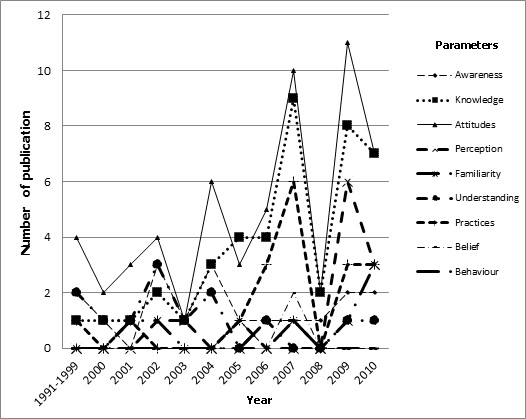 Figure 1
REFERENCES
- JACOBY A. Stigma, epilepsy, and quality of life. Epilepsy Behav 2002 ; 3: 10-20.
- SCHACHTER SC. Improving quality of life beyond seizure control. Epileptic Disord 2005; 7: 34-7.
- SHAFIQ M, TANWIR M, TARIQ A, KASI PM, ZAFAR M, SALEEM A, REHMAN R, ZAIDI SZ, TAJ F, KHUWAJA AA, SHAIKH KS, KHUWAJA AK. Epilepsy: public knowledge and attitude in a slum area of Karachi, Pakistan. Seizure 2007; 16: 330-7.
- MARTINIUK AL, SPEECHLEY KN, SECCO M, CAMPBELL MK. Development and psychometric properties of the Thinking about Epilepsy questionnaire assessing children’s knowledge and attitudes about epilepsy. Epilepsy Behav 2007; 10:595-603.
- MCNELIS AM, DUNN DW, JOHNSON CS, AUSTIN JK, PERKINS SM. Academic performance in children with new-onset seizures and asthma: a prospective study. Epilepsy Behav 2007; 10:311-18.
- AUSTIN JK, DUNN DW, JOHNSON CS, PERKINS SM. Behavioural issues involving children and adolescents with epilepsy and the impact of their families: recent research data. Epilepsy Behav 2004; 5:33-41.
- DOUGHTY J, BAKER GA, JACOBY A, LAVAUD V. Cross-cultural differences in levels of knowledge about epilepsy. Epilepsia 2003; 44:115-23.
- MIRNICS Z, CZIKORA G, ZAVECZ T, HALASZ P. Changes in public attitudes toward Epilepsy in Hungary: Results of surveys conducted in 1994 and 2000. Epilepsia 2001; 42:86-93.
- AB RAHMAN AF. Awareness and knowledge of epilepsy among students in a Malaysian university. Seizure 2005; 14:593-96.
- AL-ADAWI SH, AL-MASKARI MY, MARTIN RG, AL-NAAMANI ANH, AL-RIYAMY KA, AL-HUSSAINI AA. Attitudes of Omani physicians to people with epilepsy. Neurosciences 2000; 5:18-21.
- AL-ADAWI S, AL-SALMY H, MARTIN RG, AL-NAAMANI A, PRABHAKAR S, DELEU D, MOOSA S, DORVLO ASS. Patient’s perspective on epilepsy: self-knowledge among Omanis. Seizure 2003; 12:11-8.
- AL-ADAWI S, AL-ISMAILY S, MARTIN R, AL-NAAMANI A, AL-RIYAMY K, AL-MASKARI M, AL-HUSSAINI A. Psychosocial aspects of epilepsy in Oman: attitude of health personnel. Epilepsia 2001; 42:1476-81.
- AL-RASHED H, AL-YAHYA D, AL-KANDARI A, SHEHAB A, AL-SABAH R, AL-TAIAR A. Knowledge of, perceptions of, and attitudes toward epilepsy among university students in Kuwait. Epilepsy Behav 2009; 14:367-71.
- ATADZHANOV M, CHOMBA E, HAWORTH A, MBEWE E, BIRBECK GL. Knowledge, attitudes, behaviours, and practices regarding epilepsy among Zambian clerics. Epilepsy Behav 2006; 9:83-8.
- AUSTIN JK, SHAFER PO, DEERING JB. Epilepsy familiarity, knowledge and perceptions of stigma: report from a survey of adolescents in the general population. Epilepsy Behav 2002; 3:368-75.
- AWAD A, SARKHOO F. Public knowledge and attitudes toward epilepsy in Kuwait. Epilepsia 2008; 49:564-72.
- AYDIN K, YILDIZ H. Teachers’ perceptions in central Turkey concerning epilepsy and asthma and the short-term effect of a brief education on the perception of epilepsy. Epilepsy Behav 2007; 10:286-90.
- BAGIC A, BAGIC D, ZIVKOVIC I. First population study of the general public awareness and perception of epilepsy in Bosnia and Herzegovina. Epilepsy Behav 2009; 14:154-61.
- BAGIC A, BAGIC D, ZIVKOVIC I. First population study of the general public awareness and perception of epilepsy in Croatia. Epilepsy Behav 2009; 15:170-8.
- BENER A, AL-MARZOOQI FH, SZTRIHA L. Public awareness and attitudes towards epilepsy in the United Arab Emirates. Seizure 1998; 7:219-22.
- BHATTACHARYA AK, SAHA SK, ROY SK. Epilepsy awareness among parents of school children: a municipal survey. J Indian Med Assoc 2007; 105:243-6.
- BISHOP M, BOAG EM. Teachers’ knowledge about epilepsy and attitudes toward students with epilepsy: results of a national survey. Epilepsy Behav 2006; 8:397-405.
- BISHOP M, SLEVIN B. Teachers’ attitudes toward students with epilepsy: results of a survey of elementary and middle school teachers. Epilepsy Behav 2004; 5:308-15.
- CHOI-KWON S, PARK KA, LEE HJ, PARK MS, LEE CH, CHEON SE, YOUN MH, LEE SK, CHUNG CK. Familiarity with, knowledge of, and attitudes toward epilepsy in residents of Seoul, South Korea. Acta Neurol Scand 2004; 110:39-45.
- BOZKAYA OI, ARHAN E, SERDAROGLU A, SOYSAL AS, OZKAN S, GUCUYENER K. Knowledge of, perception of, attitudes toward epilepsy of schoolchildren in Ankara and the effect of an educational program. Epilepsy Behav 2010; 17:56-63.
- CHOMBA EN, HAWORTH A, ATADZHANOV M, MBEWE E, BIRBECK GL. Zambian health care workers’ knowledge, attitudes, beliefs, and practices regarding epilepsy. Epilepsy Behav 2007; 10:111-19.
- CHUNG K, IVEY SL, GUO W, CHUNG K, NGUYEN C, NGUYEN C, CHUNG C, TSENG W. Knowledge, attitudes and practice toward epilepsy (KAPE): a survey of Chinese and Vietnamese adults in the United States. Epilepsy Behav 2010; 17:221-27.
- CUONG LQ, THIEN DD, JALLON P. Survey of public awareness, attitudes, and understanding toward epilepsy in Nhan Chinh, Hanoi, Vietnam, in 2003. Epilepsy Behav 2006; 8:176-80.
- DANTAS FG, CARIRI GA, FILHO ARVR. Knowledge and attitudes toward epilepsy among primary, secondary and tertiary level teachers. Arq Neuropsiquiatr 2001; 59(3B).
- DAOUD A, AL-SAFI S, OTOOM S, WAHBA L, ALKOFAHI A. Public knowledge and attitudes towards epilepsy in Jordan. Seizure 2007; 16:521-6.
- DIAMANTOPOULOS N, KALEYIAS J, TZOUFI M, KOTSALIS C. A survey of public awareness, understanding and attitudes toward Epilepsy in Greece. Epilepsia 2006; 47:2154-64.
- EL-SHARKAWY G, NEWTON C, HARTLEY S. Attitudes and practices of families and health care personnel toward children with epilepsy in Kilifi, Kenya. Epilepsy Behav 2006; 8:201-12.
- FALAVIGNA A, TELES AR, ROTH F, VELHO MC, ROXO MRR, DAL BOSCO AL, DA SILVA RC, CARRER T, and al. Awareness, attitudes and perceptions on Epilepsy in Southern Brazil. Arq Neuropsiquiatr 2007; 65:1186-91.
- FONG G, HUNG A. Public awareness, attitude, and understanding of epilepsy in Hong Kong. Epilepsia 2002; 43:311-6.
- FONG CYG, HUNG A. Public awareness, attitude and understanding of epilepsy in Hong Kong Special Administrative Region, China. Epilepsia 2002; 43:311-16.
- GOURIE-DEVI M, SINGH V, BALA K. Knowledge, attitude and practices among patients of epilepsy attending tertiary hospital in Delhi, India ans a review of Indian studies. Neurology Asia 2010; 15(3): 225-32.
- GUNADHARMA, S. Public awareness, understanding and attitude towards epilepsy in Bandung, Indonesia. Neurol Asia 2004; 9:133-4.
- HAIMANOT RT, ABEBE M, FORSGREN L, MARIAM AG, HEUBEL J, HOLMGREN G, EKSTED J. Attitudes of rural people in central Ethiopia towards epilepsy. Soc Sci Med 1991; 32:203-09.
- HASAN SS, WEI WW, AHMADI K, AHMED IS, YONG AKS, ANWAR M. Knowledge and Attitudes toward Epilepsy among Malaysian Chinese. Inter J Collab Res Intern Med Pub Health 2010; 2(11): 361-76.
- HILLS MD, MACKENZIE HC. New Zealand community attitudes toward people with epilepsy. Epilepsia 2002; 43:1583-9.
- HIRFANOGLU T, SERDAROGLU A, CANSU A, SOYSAL AS, DERLE E, GUCUYENER K. Do knowledge of, perception of and attitudes toward epilepsy affect the quality of life of Turkish children with epilepsy and their parents? Epilepsy Behav 2009; 14:71-77.
- JACOBY A, GORRY J, GAMBLE C, BAKER GA. Public knowledge, private grief: a study of public attitudes to epilepsy in the United Kingdom and implications for stigma. Epilepsia 2004; 45:1405-15.
- KABIR M, ILIYASU Z, ABU BAKAR IS, KABIR ZS, FARINYARO AU. Knowledge, attitude and beliefs about epilepsy among adults in a Northern Nigerian urban community. Ann Afr Med 2005; 4:107-112.
- KALEYIAS J, TZOUFI M, KOTSALIS C, PAPAVASILIOU A, DIAMANTOPOULOS N. Knowledge and attitude of the Greek educational community toward epilepsy and the epileptic student. Epilepsy Behav 2005; 6:179-86.
- LEE H, LEE SK, CHUNG CK, YUN SN, KWON SC. Familiarity with, knowledge of, and attitudes toward epilepsy among teachers in Korean elementary schools. Epilepsy Behav 2010; 17:183-7.
- LIM KS, TAN LP, LIM KT, TAN CT. Survey of public awareness, understanding, and attitudes toward epilepsy among Chinese in Malaysia. Neurol J Southeast Asia 1999; 4:31-6.
- MASOUDNIA E. Awareness, understanding and attitudes towards epilepsy among Iranian ethnic groups. Seizure 2009; 18: 369-73.
- MBEWE E, HAWORTH A, ATADZHANOV M, CHOMBA E, BIRBECK GL. Epilepsy-related knowledge, attitudes, and practices among Zambian police officers. Epilepsy Behav 2007; 10:456-62.
- MECARELLI O, LI VOTI P, VANACORE N, D’ARCANGELO S, MINGOIA M, PULITANO P, ACCORNERO N. A questionnaire study on knowledge of and attitudes toward epilepsy in schoolchildren and university students in Rome, Italy. Seizure 2007; 16:313-9.
- MILLOGO A, SIRANYAN AS. Knowledge of epilepsy and attitudes towards the condition among schoolteachers in Bobo-Dioulasso (Burkina Faso). Epileptic Disord 2004; 6:21-6.
- NDOYE NF, SOW AD, DIOP AG, SESSOUMA B, SENE-DIOUF F, BOISSY L, WONE ISSA, TOURE K, NDIAYE M, and al. Prevalence of epilepsy, its treatment gap and knowledge, attitude and practice of its population in sub-urban Senegal an ILAE/IBE/WHO study. Seizure 2005; 14:106-11.
- NENI WS, LATIF AZA, WONG SY, LUA PL. Awareness, knowledge and attitudes towards epilepsy among rural populations in East Coast Peninsular Malaysia: a preliminary exploration. Seizure 2010; 19:280-90.
- NJAMNSHI AK, BISSEK ACZK, YEPNJIO FN, TABAH EN, ANGWAFOR SA, KUATE CT, et al. A community survey of knowledge, perceptions and practice with respect to epilepsy among traditional healers in the Batibo Health District, Cameroon. Epilepsy Behav 2010; 17:95-102.
- NJAMNSHI AK, YEPNJIO FN, BISSEK ACZK, TABAH EN, ZOGO PO, DEMA F, ANGWAFOR SA, and al. A survey of public knowledge, attitudes and practices with respect to epilepsy in Badissa Village, Centre Region of Cameroon. Epilepsy Behav 2009; 16:254-9.
- NJAMNSHI AK, TABAH EN, YEPNJIO FN, ANGWAFOR SA, DEMA F, FONSAH JY, KUATE CT, and al. General public awareness, perceptions, and attitudes with respect to epilepsy in the Akwaya Health District, South-West Region, Cameroon. Epilepsy Behav 2009; 15:179-85.
- NJAMNSHI AK, ANGWAFOR SA, TABAH EN, JALLON P, MUNA WFT. General public knowledge, attitudes, and practices with respect to epilepsy in the Batibo Health District, Cameroon. Epilepsy Behav 2009; 14:83-8.
- NJAMNSHI AK, TABAH EN, BISSEK ACZK, YEPNJIO FN, ANGWAFOR SA, DEMA F, FONSAH JY, and al. Knowledge, attitudes and practices with respect to epilepsy among student nurses and laboratory assistants in the South West Region of Cameroon. Epilepsy Behav 2010; 17:381-88.
- NJAMNSHI AK, YEPNJIO FN, TABAH EN, DEMA F, ANGWAFOR SA, FONSAH JY, and al. Public awareness, perceptions, and attitudes with respect to epilepsy in Ebolowa and Sangmelima – Urban Cameroon. Epilepsy Behav 2009; 14:628-33.
- OTOOM SA, AL-SAFI SA, SEQUEIRA RP, ALKOFAHI AS. Knowledge of management of epilepsy in young adults in Jordan. Epilepsy Behav 2006; 9: 349-54.
- PANDIAN JD, SANTOSH D, KUMAR TS, SARMA PS, RADHAKRISHNAN K. High School students’ knowledge, attitude, and practice with respect to epilepsy in Kerala, Southern India. Epilepsy Behav 2006; 9:492-7.
- RAFAEL F, DUBREUIL CM, BURBAUD F, TRAN DS, CLEMENT JP, PREUX PM, NUBUKPO P. Knowledge of epilepsy in the general population based on two French cities: implications for stigma. Epilepsy Behav 2010; 17:82-6.
- RAMASUNDRUM V, MOHD HUSSIN ZA, TAN CT. Public awareness, attitudes and understanding towards epilepsy in Kelantan, Malaysia. Neurol J Southeast Asia 2000; 5:55-60.
- RWIZA HT, MATUJA WB, KILONZO GP, HAULE J, MBENA P, MWANG OMBOLA R, JILEK-AALL L. Knowledge, attitude, and practice toward epilepsy among rural Tanzanian residents. Epilepsia 1993; 34:1017-23.
- SAENGPATTRACHAI M, SRINUALTA D, LORLERTRATNA N, PRADERMDUZZADEEPORN E, POONPOL F. Public familiarity with, knowledge of, and predictors of negative attitudes toward epilepsy in Thailand. Epilepsy Behav 2010 (article in press).
- TEDRUS GMAS, FONSECA LC, VIEIRA ALDC. Knowledge and attitudes toward epilepsy amongst students in the health area: intervention aimed at enlightenment. Arq Neuropsiquiatr 2007; 65:1181-85.
- THACKER AK, VERMA AM, JI R, THACKER P, MISHRA P. Knowledge, awareness and attitude about epilepsy among schoolteachers in India. Seizure 2008; 17:684-90.
- Tran DS, Odermatt P, Singphuoangphet S, Cabanac MD, Preux PM, Strobel M, Barennes H. Epilepsy in Laos: Knowledge, attitudes and practices in the community. Epilepsy Behav 2007; 10:565-70.
- TUAN NA, CUONG LQ, ALLEBECK P, CHUC NTK, TOMSON T. Knowledge, attitudes and practice toward Epilepsy among adults in Ba Vi, Vietnam: first report from the population-based EPIBAVI study. Epilepsia 2007; 48:1914-19.
- WIN NN, SOE C. Public awareness, attitude and understanding toward epilepsy among Myanmar people. Neurol J Southeast Asia 2002; 7:81-8.
- WONG V, CHUNG B, WONG R. Pilot survey of public awareness, attitudes and understanding towards epilepsy in Hong Kong. Neurol Asia 2004; 9:21-7.
- YOO JK, JUNG KY, PARK KW, LEE DH, LEE SK, LEE IK, CHO YW, KIM MK. Familiarity with, understanding of, and attitudes toward epilepsy among people with epilepsy and healthy controls in South Korea. Epilepsy Behav 2009; 16:260-7.
- YOUSSEF FF, DIAL S, JAGGERNAUTH N, JAGDEO CL, PASCALL A, RAMESSAR L and al. Knowledge of, attitudes toward, and perceptions of epilepsy among college students in Trinidad and Tobago. Epilepsy Behav 2009; 15:160-65.
- MITTAN RJ. Psychosocial treatment programs in epilepsy: A review. Epilepsy Behav 2009; 16:371-80.
- CRESSWELL JA. Research design, qualitative and quantitative approaches. London: Sage; 2002. p. 4-16.
- GREEN J, THOROGOOD N. Qualitative methods for health research. London: Sage; 2004.
|
|
