
|
|||||||||||||||||||||||||||||||||||||||||||||||||||||||||||||||||||||||||||||||||||||||||||||||||||||||||||||
|
ORIGINAL PAPERS / ARTICLES ORIGINAUX
EXPERIENCE AND OUTCOMES OF THROMBOLYSIS FOR ISCHEMIC STROKE IN SUB-SAHARAN AFRICA: INSIGHTS FROM IVORY COAST
EXPÉRIENCE ET RÉSULTATS DE LA THROMBOLYSE POUR AVC ISCHÉMIQUE EN AFRIQUE SUBSAHARIENNE: APERÇU DE LA CÔTE D’IVOIRE
E-Mail Contact - DIAKITE ISMAILA :
di.smael@yahoo.fr
Résumé : La thrombolyse intraveineuse est un traitement largement utilisé dans les pays développés depuis plusieurs années. Cependant, son utilisation en Afrique reste limitée en raison du manque d’infrastructures, qui constitue un obstacle important au traitement par thrombolyse dans les pays en développement, en particulier dans les pays d’Afrique subsaharienne. En Côte d’Ivoire, l’activité de thrombolyse n’a commencé qu’en 2017. Nous rapportons 20 cas de patients, 11 hommes et 9 femmes, avec un âge moyen de 57,25 ans. L’hypertension artérielle était le facteur de risque prédominant et l’athérosclérose était le facteur étiologique le plus incriminé (9/20). Le score NIHSS initial moyen était de 10,17, et le délai moyen entre l’apparition de la maladie et l’admission du patient était de 76,78 minutes, le « Door to needle time » étant de 99,20 minutes. Le score NIHSS moyen dans les 24 heures était de 7 (n=17). Onze patients ont eu un bon résultat à 3 mois (mRs M3 entre 0 et 1), tandis que deux patients sont décédés au cours de la même période. Mots-clés : Afrique subsaharienne, AVC ischémique, thrombolyse intraveineuse. Abstract: Intravenous thrombolysis has been a widely used treatment in developed countries for several years. However, its utilization in Africa is still limited due to the lack of infrastructure, which is a significant barrier to thrombolysis therapy in developing countries, particularly in sub-Saharan African countries. In Ivory Coast, thrombolysis activity only began in 2017. We have reported a case series of thrombolytic therapy in Côte d’Ivoire between 2017 and 2021, involving 20 patients, 11 men and 9 women, with a mean age of 57.25 years. High blood pressure was the predominant risk factor, and atherosclerosis was the most incriminating etiologic factor (9/20). The mean initial NIHSS score was 10.17, and the mean time from onset to patient admission was 76.78 minutes, with the « Door to needle time » being 99.20 minutes. The mean NIH score within 24 hours was 7 (n=17). Eleven patients had a good outcome at 3 months (mRs M3 between 0 and 1), while two patients died within the same period. Keywords: Sub-Saharan Africa, ischemic stroke, intravenous thrombolysis. Introduction: The thrombolysis in sub-Saharan African countries is limited. The literature on the management and outcomes of acute ischemic stroke AIS) (in this part of the world countries is scarce [2,15]. It is crucial to gather more data on the management and outcomes of acute ischemic stroke in these countries to inform evidence-based strategies and interventions. In Cote d’Ivoire, the earliest record of cerebral thrombolysis for AIS dates from April 2017 to October 2021 with a cohort of 10 patients [9]. In this study, the authors aimed to provide an update on the management and outcomes of eligible patients who underwent rt-TPA thrombolysis within the last five years. in this under-equipped environment. Methods Study design and patient selection This retrospective study was conducted from October 2017 to October 2021 and included patients presenting with ischemic stroke within 4.5 hours of symptom onset. All patients were evaluated in the emergency unit of Sainte Anne Marie Polyclinic in Abidjan and subsequently assessed by neurologists to determine eligibility for thrombolytic therapy. Intravenous thrombolysis was administered after obtaining written informed consent from patients who met the inclusion criteria and had no history of recent major surgery, ischemic stroke within the previous three months, intracranial hemorrhage, or known bleeding disorders. Intervention A team of three neurologists collaborated with emergency physicians in an institution where Alteplase was readily available to perform intravenous rt-PA. Upon arrival of patients in the emergency department, the neurology team was notified. The administration of intravenous rt-PA was carried out with a neurologist present on-site or via a telestroke platform using WhatsApp. Following the procedure, patients were transferred to the intensive care unit for an average of 72 hours of post-procedure before being discharged. Data collection Data for this study were obtained from hospitalization records using a standardized questionnaire (Appendix 1). Collected variables included sociodemographic characteristics, vascular risk factors, exact time of symptom onset, admission time, and findings from the initial neurological examination, including the National Institutes of Health Stroke Scale (NIHSS) score at presentation (NIHSS H0). Additional data encompassed stroke etiology, timing of neuroimaging, length of hospital stay, and all parameters related to intravenous thrombolysis, such as treatment initiation and completion times, door‑to‑needle interval, and the occurrence of symptomatic intracranial hemorrhage. Etiologic evaluation included a cell blood count, coagulation labs, ultrasonography of the cervical great vessels, transthoracic echocardiography with bubble study, lipid profile, and HbA1c assessment. Outcome measures Primary outcomes were the proportion of patients achieving significant early neurological recovery defined as an improvement of 4 or more points on the National Institutes of Health stroke scale (NIHSS) score. The secondary outcomes were the modified Rankin Scale at 3 months post ictus (mRS M3). A mRS M3=0 or 1 was considered favorable. The safety endpoint was the rate of symptomatic intracranial hemorrhage (sICH), and mortality. Statistical analysis Analysis and visualization of the data were conducted using GraphPad Prism version 9 software. Before analysis, the dataset was assessed for normal distribution using the Shapiro-Wilk test. Normally distributed continuous data were presented using the mean and standard deviation, while non-normally distributed data were expressed using the median and 25-75% percentile. Categorical data were reported as percentages. Statistical significance was determined using a threshold of p-value < 0.05. Ethical consideration The study was approved by the Ethics Committee of the University Felix Houphouët Boigny – Abidjan – Ivory Coast. Results Table S1 summarize the demographics, clinics, etiology, time management and outcomes data. Demographics and risk factors Throughout the five-year observational period, a total of 21 patients met the eligibility criteria for rt-PA therapy, resulting in an estimated caseload of 4 patients per annum. Among these patients, 12 were male and 9 were female, yielding a sex ratio of 1.33. The demographic attributes and associated risk factors have been concisely outlined in Table 1. The median age of the patient cohort was 64 years. Notably, the three most prevalent risk factors observed were high blood pressure (57.14%), dyslipidemia (28.57%), and heart disease (23.81%). Clinical symptoms and etiology The clinical manifestations primarily consisted of hemiparesis, which was observed in 71.43% of cases, followed by Broca aphasia and dysarthria, reported in 57.14% of patients, and hemiplegia, observed in 23.81% of cases (refer to Table 1). Other reported symptoms included seizures, headache, impaired vigilance, hemineglect, and sensory extinction. The mean initial National Institutes of Health Stroke Scale (NIHSS H0) score was 10 +/- 5.71, which corresponds to a moderate stroke. Brain CT scans were conducted for all patients, revealing an occlusion in the sylvian territory (M1/M2) in 10 cases. Additionally, one case showed hypo-vascularisation in the pontine/basilar artery territory. Notably, among the ten patients with normal brain CT scans, three underwent further MRI evaluation after thrombolysis, which confirmed a diagnosis of sylvian ischemic stroke. Etiologically, atherosclerosis emerged as the most prevalent factor, accounting for 42.85% of cases, followed by cardiogenic embolism at 19.04%. Carotid web and thrombocythemia associated with atherosclerosis were each implicated in one case. Moreover, two patients were diagnosed with « stroke mimic, » and three patients showed no abnormalities in their CT scans. Time management The average delay from the onset of symptoms to hospital admission was 76.6 +/- 37.1 minutes. Specifically, 11 cases had symptom onset in the morning, while 5 cases occurred in the afternoon and 5 cases in the evening. It is noteworthy that patients whose symptoms manifested in the evening had the shortest average delay to hospital admission (mean time: 60.75 minutes), while those with symptom onset in the afternoon experienced the longest delay (mean time: 82 minutes). However, due to the limited number of cases in each group, statistical analysis was deemed inconclusive. The time taken from patient admission to brain imaging was 59 +/- 36.8 minutes, with the quickest imaging performed in 14 minutes. Regarding the « door to needle time, » which indicates the duration from hospital admission to the initiation of intravenous rt-PA therapy, the average time was 103 +/- 36.5 minutes, and the fastest recorded time was 32 minutes. The mean time from symptom onset to the administration of intravenous rt-PA was 180 +/- 46.1 minutes, with the shortest time being 87 minutes. Outcomes The mean National Institutes of Health Stroke Scale (NIHSS) score at 24 hours (NIHSS H24) was 7 +/- 7.05, indicating the average neurological impairment experienced by patients at this time point. Notably, eight (38.1%) of experienced a significant early neurological recovery with rt-PA (p=0.0003; paired t-test), as demonstrated in Figure 1. This improvement suggests the beneficial effect of rt-PA in reducing neurological deficits. Post-thrombolysis, four patients experienced neurologic deterioration with symptomatic bleeding. These patients had a median age of 72.25 years, and their initial NIHSS scores (NIHSS H0) ranged from 14 to 20. The median duration of hospitalization for these cases was 7 days (with a range of 4 to 14 days). At 3 months, the mean modified Rankin score (mRs M3) was 1.85 +/- 2.46. Of the total patients, 11 were considered cured at 3 months, with an mRs M3 score of 0-1, implying minimal to no disability. Additionally, 14 patients achieved independence, with an mRs M3 score of 0-2, showcasing a satisfactory level of functional recovery. Discussion: In this study, we provide an update on the status of intravenous rt-PA performed in Côte d’Ivoire until October 2021. Our series has shown promising results in terms of improving neurological outcomes, over one-third of patients experienced early recovery with a significant reduction in NIHSS scores at 24 hours. Although some patients experienced symptomatic bleeding, most patients achieved favorable outcomes, with a significant proportion reaching either a complete cure or a state of functional independence at the 3-month follow-up. No mortality was recorded. Risk factors and epidemiology of acute ischemic stroke Worldwide, the incidence of ischemic stroke is on the rise, especially in sub-Saharan Africa. In 2016, about 80.1 million stroke survivors were reported globally with nearly 84% being ischemic stroke [8]. In Cote d’Ivoire, 14502 incident cases with 10788 deaths were reported the same year. The rising incidence of ischemic stroke is attributed in part to the aging population, lifestyle changes, and increased prevalence of comorbidities such as hypertension, diabetes, and obesity. In our cohort, high blood pressure, dyslipidemia, and heart disease were the top three major risk factors encountered. This is different from INTERSTROKE, the largest case-control study on stroke so far, which reported mainly alcohol intake, cardiac causes, and high blood pressure among Africans [13]. Our finding cannot be extrapolated given the small number of patients in our study. Interestingly, INTERSTROKE reported variations in the relative importance of some modifiable risk factors by regions in the world. For instance, they found the magnitude odd ratio of alcohol intake higher in sub-Saharan Africa than in the rest of the world whereas Asia had a higher odd ratio of cardiac causes and diet-related risk factors. Additionally, they found that smoking, diabetes mellitus and apolipoproteins were significant risk factors for ischemic stroke but not hemorrhagic stroke [13]. Further investigations focused on sub-Saharan Africans will provide a more accurate picture of the specific risk factors. As shown in our cohort, AIS affects young adults and even younger individuals in Africa [6-14]. Rt-PA-eligible patients in Africa presented with moderate neurological symptoms [9, 18]. Unlike NINDS Study, we found atherosclerosis as the main etiology. This can be related to a selection bias given in our small population size. Two patients in our series were considered « stroke mimics. For these « stroke mimics », the performance of thrombolysis can be explained by the emergency context. Indeed, the shorter the « door to needle time », the greater the risk of treating « stroke mimics » [12]. Patient circuit to rt-PA The prompt onset of appropriate medical intervention is of paramount importance in the management of acute ischemic stroke, as it significantly influences patient outcomes. In this study, we examined the temporal aspects of patient care from symptom onset to hospital admission, subsequent diagnostic imaging, and the initiation of intravenous rt-PA therapy. Our findings shed light on the critical time intervals involved in the acute stroke care pathway. The average delay from the onset of stroke symptoms to hospital admission, as evidenced by our results, is within the recommended time window for effective thrombolytic therapy [1,3]. Our analysis of the distribution of symptom onset across different times of day revealed intriguing variations. Specifically, a notable proportion of cases presented with symptom onset in the evening, which interestingly correlated with the shortest average delay to hospital admission (mean time: 60.75 minutes). This suggests that patients experiencing symptoms later in the day might have more prompt access to medical care unlike cases with symptom onset in the afternoon who had the longest delay (mean time: 82 minutes). The duration from patient admission to brain imaging is a crucial determinant in guiding treatment decisions. Our study indicates an average time of 59 ± 36.8 minutes for this step, with the quickest imaging performed in an impressive 14 minutes. This rapid diagnostic turnaround time underscores the efficiency of our clinical protocols in promptly assessing the extent of cerebral ischemia. Achieving expedited brain imaging not only aids in accurate diagnosis but also facilitates the timely initiation of appropriate therapeutic interventions. To the best of our knowledge, this is the shortest time in Africa [3, 5, 18]. Young adults are more likely to present outside the time window for rt-PA. In a Senegalese study, only 33.9% of patients with acute ischemic stroke presented to the hospital within three hours [6]. A study investigating predicting risk factors of delayed presentation identified diabetes mellitus, single status, and unemployed status. Although non-significant, female patients tend also to present late [6, 16-17]. Despite poor emergency medical transportation in our context, the study population had an average onset-to-door time of 76,78 minutes; which parallels settings in developed countries [1]. The « door to needle time, » representing the duration from hospital admission to the initiation of intravenous rt-PA therapy, is a pivotal indicator of the overall efficiency of acute stroke care. Our investigation reveals an average « door-to-needle time » of 103 ± 36.5 minutes, with the fastest recorded time being a remarkable 32 minutes. This finding demonstrates our commitment to streamlining treatment delivery and highlights the potential for further improvement in reducing treatment delays. The mean time from symptom onset to the administration of intravenous rt-PA was 180 ± 46.1 minutes, with the shortest time recorded at 87 minutes. While this interval is reflective of the current guidelines, our study emphasizes the need for continued efforts to expedite thrombolytic therapy initiation. Earlier administration of rt-PA has been associated with better patient outcomes and reduced disability, reinforcing the urgency of minimizing delays in treatment initiation. Outcomes of rt-PA The average NIHSS score at 24 hours indicates a moderate level of initial neurological impairment, with a notable improvement in eight patients treated with rt-PA. However, caution is warranted, as symptomatic bleeding post-thrombolysis led to neurologic deterioration in four patients, primarily among older individuals with higher initial NIHSS scores. Elderly patients seem more susceptible to bleeding [5, 19]. While research conducted in developed nations substantiates the safety of tPA administration among elderly patients, we maintain the perspective that this demographic group exhibits greater susceptibility within resource-constrained countries. Despite these complications, most patients achieved favorable outcomes, with a mean modified Rankin score of 1.85 at 3 months. This indicates a relatively low level of disability, with 11 patients showing minimal to no disability and 14 achieving a satisfactory level of functional recovery. These findings align with and contribute to the existing literature on rt-PA’s efficacy and potential risks, emphasizing the need for careful patient selection and monitoring during thrombolytic therapy [1, 4]. Challenges and perspective The critical window for thrombolytic therapy is narrow, making the urgency of treatment even more pronounced, especially in low-middle-income countries such as Sub Sahara Africa where there are limited medical and paramedical services. Among the main challenges is the lack of resources, including trained personnel, diagnostic tools, and medication [10]. Additionally, there are issues with timely and accurate diagnosis of stroke, which can delay the administration of rt-PA. Addressing these challenges necessitates a multifaceted approach, involving improvements in healthcare infrastructure, medical education, and increased availability of essential medications to enhance stroke care in this region. In Cote d’Ivoire, only one private center has the equipment to offer rt-TPA. This fact considerably limits the accessibility of acute timely intervention. Nonetheless, with 21 patients, the number of intravenous rt-PA reported in Côte d’Ivoire is the highest in West Africa [9]. This number is lower compared to reports from Morocco in North Africa and South Africa [16, 17]. Several initiatives are being undertaken to improve the management of acute ischemic stroke in the country. Efforts are being made to increase the workforce and infrastructure. Since 2017, the number of skilled neurologists for rt-PA increased from one to three which is complemented by a fellowship-trained endovascular neurosurgeon who performed mechanical thrombectomy. Two additional healthcare facilities are now available for both rt-PA and thrombectomy in the country. Yet, challenges remain to increase public awareness and treatment affordability. Study limitation While this study on the outcomes of 21 patients who underwent rt-PA provides valuable insights into the efficacy and impact of this treatment, it is essential to acknowledge several potential limitations that might influence the interpretation and generalizability of our findings. Firstly, the relatively small population limits the statistical power of your study, potentially hindering the ability to detect and analyze more risk factors. The single-center nature of the study could introduce bias and restrict the diversity of patient profiles. Additionally, the absence of a control group or a comparative intervention arm makes it challenging to establish a direct cause-and-effect relationship between rt-PA administration and the observed outcomes. The lack of long-term follow-up data might also hinder a comprehensive understanding of the treatment’s durability and potential late effects. Conclusion In conclusion, our case series sheds light on the evolving landscape of thrombolytic therapy in Côte d’Ivoire, offering valuable insights into its implementation and outcomes between 2017 and 2021. Despite the challenges posed by limited infrastructure and resources, the initiation of thrombolysis activity marks a significant step forward in addressing acute ischemic stroke within the country. Our study underscores the predominant role of high blood pressure as a risk factor and highlights atherosclerosis as a prevailing etiological factor in this patient population. This case series contributes to the emerging body of evidence supporting the feasibility and efficacy of thrombolytic therapy in Côte d’Ivoire and emphasizes the need for continued efforts to enhance stroke care infrastructure and optimize treatment pathways. As thrombolysis gains traction within the country, further studies with larger cohorts and longer follow-up durations are warranted to better understand the factors influencing treatment outcomes and to guide ongoing advancements in stroke management. Through collaborative endeavors and focused interventions, we remain poised to refine the landscape of stroke care in Côte d’Ivoire and improve the prognosis and quality of life for stroke patients in the region. Conflicts of interest: The authors declare no conflicts of interest.
MCA: Middle cerebral artery. 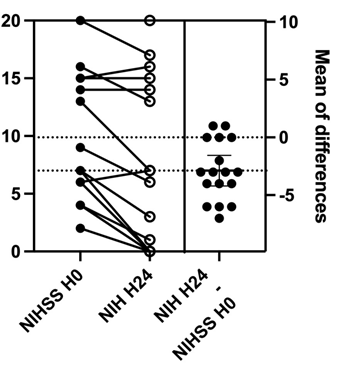 Figure 1: Comparison of NIHSS at H0 vs H24 In the left column, each black dot corresponds to the NIHSS H0 score for patients and each white dot correspond to a NIHSS H24 score. The solid black lines link the pre therapeutic NIHSS H0 score to the post therapeutic NIHSS H24 score. The left column indicates the difference in NIHSS Score between the post therapeutic (H24) and the pre therapeutic status (H0). A difference that is above zero means a deterioration, at zero means no improvement or deterioration and below zero means an improvement. Overall, the comparison indicates two cases of deteriorations, three cases of stable outcomes and 17 cases of neurologic improvement at H24. NIHSS at 24hours after thrombolysis showed a significant neurological improvement. table 1 : Epidemiological data 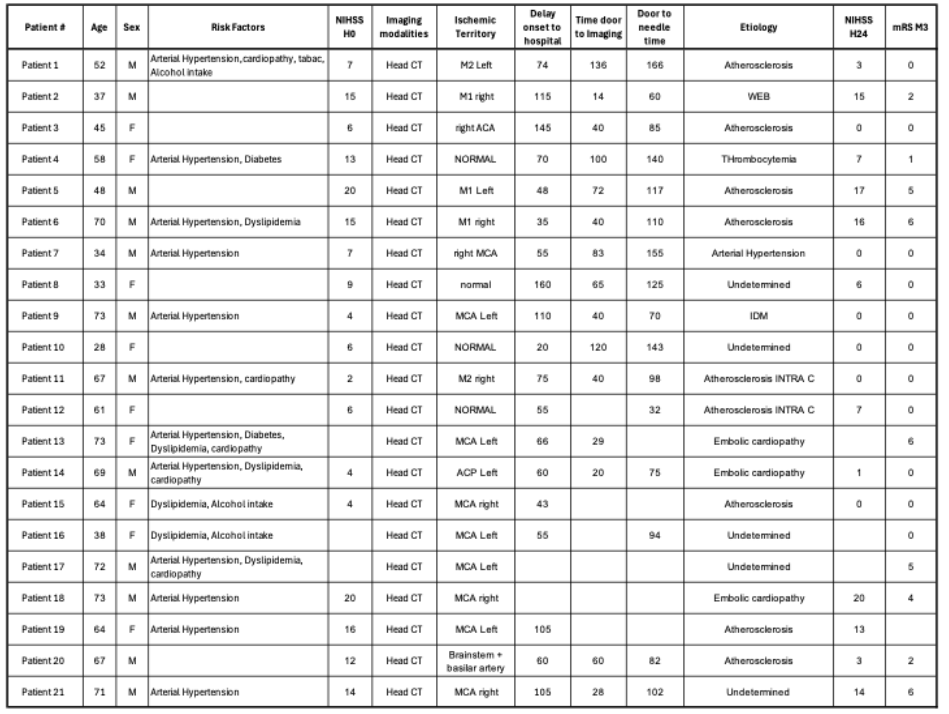 REFERENCES
|
|||||||||||||||||||||||||||||||||||||||||||||||||||||||||||||||||||||||||||||||||||||||||||||||||||||||||||||
© 2002-2018 African Journal of Neurological Sciences.
All rights reserved. Terms of use.
Tous droits réservés. Termes d'Utilisation.
ISSN: 1992-2647